
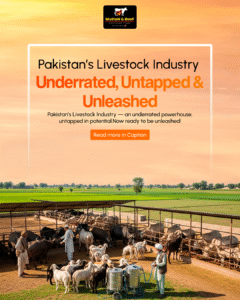
 Pakistan is home to one of the largest livestock populations in the world, yet Pakistan’s livestock sector remains underdeveloped and undervalued. Despite contributing over 60% to the agricultural GDP, inefficiencies in farming practices, weak veterinary infrastructure, and fragmented supply chains prevent the country from becoming a global leader in meat production, particularly mutton and beef staples in the Pakistani diet. In this blog, we explore the hurdles facing Pakistan’s livestock, and how modern practices and responsible brands like Mutton & Beef by BSF are reshaping the industry.
Livestock: The Backbone of Rural Pakistan
Livestock is more than just an industry; it is the lifeline for millions of rural families. Farmers rely on cows, buffaloes, goats, and sheep to sustain livelihoods. However, traditional farming methods, limited resources, and lack of modern infrastructure keep productivity low.
Small-scale farms dominate Pakistan’s livestock sector, with most households maintaining only 2–5 cows or buffaloes and a few goats or sheep. Limited grazing land, inconsistent feed, and minimal access to veterinary services lead to low meat yield, poor animal health, and unpredictable supply. When the foundation is weak, the entire sector suffers.
 Poor Breed Quality and Genetic Limitations
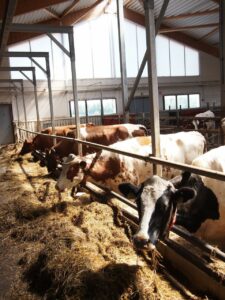 Poor Breed Quality and Genetic Limitations
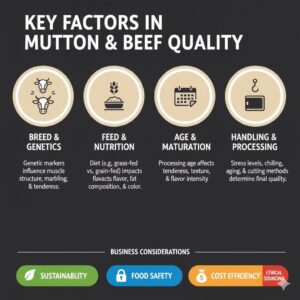
One major reason for low productivity in Pakistan’s livestock is the lack of scientific breeding programs. Unlike countries such as Australia and Brazil, Pakistan largely relies on random mating, weak genetics, and poor-quality bulls. There is no national breed development program, leading to slower growth, lower meat production, and reduced immunity among animals.
Feed and Nutrition Gaps
Balanced nutrition is critical for healthy livestock and quality meat production. Yet, in Pakistan:
- Farmers depend mostly on natural grazing.
- Feed quality is inconsistent and often inadequate.
- Scientific feeding practices are rare.
- High feed costs force farmers to compromise, resulting in malnourished animals.
Consequently, poor nutrition contributes to slow growth and lower-quality beef and mutton, directly impacting profitability and export potential.
Weak Veterinary Infrastructure
Healthcare for livestock is severely underdeveloped. Pakistan faces:
- A scarcity of trained veterinarians.
- Low vaccination coverage.
- Poor disease control for ailments like Foot-and-Mouth Disease (FMD), Lumpy Skin Disease (LSD), and Hemorrhagic Septicemia (HS).
- Limited emergency medical support.
Diseases not only reduce meat yield but also affect farmer income and prevent access to international markets.
Outdated Farming Practices
Much of Pakistan’s livestock production still depends on manual labor, traditional feeding, and old breeding techniques. Modern technology; AI-assisted breeding, digital monitoring, climate-controlled sheds, and health tracking is largely absent. The result: inefficient production and compromised meat quality.
Market Inefficiencies: Middlemen and Supply Chains
Middlemen dominate the livestock market, taking significant margins and leaving farmers underpaid while customers overpay. The lack of transparency discourages professional farming and standardization.
Transportation is another weak link: livestock is often moved over long distances in crowded, stressful conditions, resulting in injuries, weight loss, and reduced meat quality. Poor supply chain and logistics systems make Pakistan’s livestock industry less competitive both locally and internationally.
 Lack of Meat Processing and Cold Chain Facilities
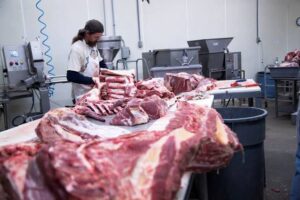 Lack of Meat Processing and Cold Chain Facilities
Pakistan suffers heavy post-production losses due to inadequate processing and storage facilities. The gaps include:
- Few modern slaughterhouses.
- Lack of temperature-controlled logistics.
- No standardized packaging or quality certification.
These deficiencies reduce domestic meat quality and prevent entry into high-value export markets.
Low Government Prioritization
Livestock is rarely treated as a national priority. Weak policies, minimal subsidies, lack of long-term planning, and insufficient research investments have left Pakistan’s livestock sector underdeveloped despite its potential.
Untapped Export Potential
With proper infrastructure and standards, Pakistan could emerge as a leading meat exporter to the Middle East, Central Asia, and Africa. Halal-certified processing plants, disease-free zones, quality assurance systems, and temperature-controlled logistics are essential for unlocking this potential.
The Way Forward: Modernization and Discipline
To truly harness the power of Pakistan’s livestock, the sector requires a complete transformation:
- Large-scale, modern farming methods.
- Technology-driven breeding and monitoring.
- Improved feed management.
- Strengthened veterinary systems.
- Regulated and transparent markets.
- Cold chain infrastructure for processing and transport.
- Brand-led quality standards.
How Mutton & Beef by BSF is Leading Change
Brands like Mutton & Beef by BSF are pioneering this transformation. Their model focuses on:
- Quality-controlled sourcing.
- Ethical farming practices.
- Professional animal handling.
- Hygienic slaughtering methods.
- Temperature-controlled logistics.
- Transparent supply chains.
- Standardized meat quality.
By doing so, Mutton & Beef by BSF:
- Reduces the role of middlemen.
- Increases farmer income.
- Ensures high-quality, hygienic meat.
- Builds customer trust.
- Sets national standards for professionalism and transparency.
If more brands adopt such modern approaches, Pakistan can shift from an underdeveloped livestock sector to a professional, scalable, and export-ready industry.
 FAQ’s:
 FAQ’s:
1. Why is Pakistan’s livestock sector underdeveloped?
It depends heavily on small-scale farming, outdated practices, weak veterinary care, fragmented supply chains, and limited government support.
2. What is the biggest challenge in livestock production?
Low productivity caused by poor genetics, weak feed, and insufficient healthcare.
3. Can Pakistan become a major meat exporter?
Yes, but only with modern slaughterhouses, disease-free zones, cold-chain logistics, and international standards.
4. How can private companies improve the sector?
By standardizing sourcing, handling, processing, and transport, as Mutton & Beef by BSF is demonstrating.
5. How will modernizing livestock benefit Pakistan?
It will increase GDP, create rural jobs, stabilize meat prices, and boost export revenue.